Travel CPAP Power: TSA, FAA, and Battery Rules for Sleep Apnea Travelers
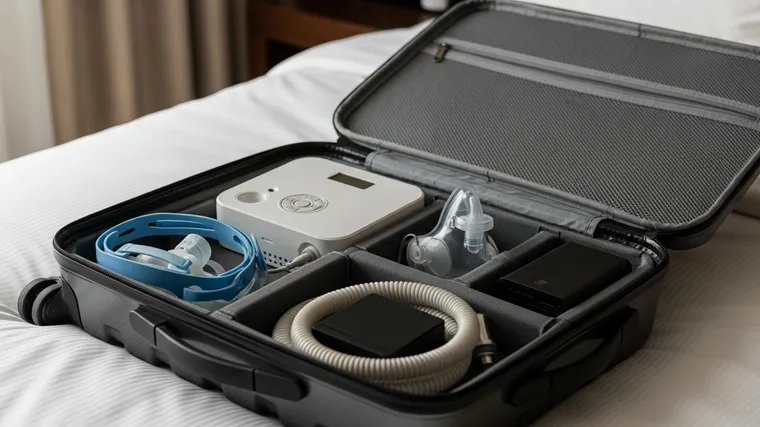
Why this matters for CPAP travelers
If you’ve shopped for a portable power station to keep your CPAP running on a trip, you’ve probably been surprised to learn that the same battery you’d buy for a power outage at home is flatly prohibited on a US commercial flight. The FAA cares about lithium-ion energy density, not what the battery is “for.” A Jackery 1000 doesn’t get an exemption just because you’re using it for a medical device.
This guide covers what you can actually fly with, how the medical-device rules work, and the specific products that meet airline requirements.
The 100Wh rule, in plain English
The FAA splits lithium batteries into three tiers:
| Battery size | Carry-on | Checked | Notes |
|---|---|---|---|
| Under 100 Wh | Yes (no approval needed) | No (lithium banned in checked) | Phones, laptops, small CPAP batteries |
| 100-160 Wh | Yes, with airline approval | No | Limited to 2 per passenger; pro camera batteries |
| Over 160 Wh | Prohibited | Prohibited | All full-size portable power stations |
Most travelers don’t realize how restrictive 100Wh is. A typical laptop battery is 50-80Wh. A Jackery Explorer 500, marketed as the “small” portable power station, is 518Wh — over five times the carry-on limit. Even the EcoFlow River 2 (256Wh) is too big.
For a sense of how this collides with CPAP needs: a single night of CPAP-only therapy uses 30-60Wh, so a 95Wh battery covers one to two nights without a humidifier. Add a heated humidifier and you’re past the legal carry-on limit before you even land.
The medical-device exemption (and what it doesn’t cover)
US airlines and the FAA classify CPAP machines as personal medical devices. This gives you four real benefits:
- The CPAP itself doesn’t count toward your carry-on limit. Bring it in addition to your normal carry-on and personal item.
- You can use it in flight with airline notification.
- TSA screening is faster — declare the CPAP, agents are trained on it.
- Airline gate-checking is avoided for full overhead bins.
What the exemption does not do:
- It does NOT raise the 100Wh battery limit. The medical device is exempt; the lithium chemistry inside accessories is not.
- It does NOT cover universal power stations even if you only use them for CPAP.
- It does NOT let you put a battery in checked baggage. Lithium-ion is prohibited in the hold for fire-safety reasons, full stop.
CPAP-specific batteries that actually fly
These are the realistic options if you need battery backup on a plane:
| Battery | Capacity | CPAP compatibility | Approx. nights (no humidifier) |
|---|---|---|---|
| Medistrom Pilot-24 Lite | 95 Wh | ResMed AirSense 10/11, most 24V CPAPs | 1-2 nights |
| Medistrom Pilot-12 Lite | 75 Wh | 12V CPAPs (older Philips, Transcend) | 1 night |
| ResMed Power Station II | 97 Wh | ResMed AirSense, S9 series | 1-2 nights |
| Transcend Travel CPAP internal | ~25-50 Wh | Transcend-only | 1 night |
Common pattern: these all sit just below the 100Wh airline ceiling, none have AC inverters (they output DC directly to the CPAP), and none can run a heated humidifier for a meaningful duration. You travel without humidifier, full stop.
What about universal power stations like Jackery or EcoFlow?
Don’t bring them on a plane. They are prohibited:
- Jackery Explorer 1000 — 1002Wh, prohibited
- Jackery Explorer 500 — 518Wh, prohibited
- EcoFlow Delta 2 — 1024Wh, prohibited
- EcoFlow River 2 Pro — 768Wh, prohibited
- Goal Zero Yeti 500X — 505Wh, prohibited
- Bluetti AC180 — 1152Wh, prohibited
These belong in a checked car trip, an RV, or an Airbnb you ship them ahead to. They do not belong in a suitcase.
If a TSA agent finds one in your carry-on, expect it to be confiscated and possibly destroyed at the airport. The agent isn’t going to weigh the cost-benefit for you.
What to actually pack for an air trip
For a domestic or international trip with CPAP:
- CPAP machine in its travel case, in carry-on
- One CPAP-specific battery under 100Wh (Medistrom Pilot-24 Lite or ResMed Power Station II), also carry-on
- All cables, hose, mask in carry-on — never check
- Doctor’s note stating CPAP is required for medically necessary therapy
- Battery spec sheet printed, showing watt-hours below 100
- Country-specific power adapter for your destination (the universal-input AC charger handles most voltage differences, but plug shape varies)
Skip the humidifier on travel. Use saline nasal spray or a small room humidifier on AC at the destination. Trying to run a heated humidifier on a 95Wh battery will give you maybe 90 minutes of runtime.
What about gate-checking risk?
Sometimes the airline’s overhead bins fill before you board, and gate agents start asking passengers to check carry-ons. Refuse gate-check for anything containing a lithium battery.
Make this clear politely: “This is a medical device with a lithium battery and it’s prohibited from checked baggage by FAA regulation.” A gate agent who insists is overruled by FAA Hazmat 49 CFR 175.10. Stand your ground and ask for a supervisor if needed.
For your CPAP machine itself, if it must be gate-checked, that’s annoying but legal — the machine doesn’t have a lithium battery in it. The risk is physical damage in transit, not regulatory.
International notes
Most ICAO-member countries (which is essentially every country with commercial aviation) follow the same 100Wh rule. The medical-device exemption is also common but not universal — verify with your specific airline before flying outside the US.
A few quirks:
- EU: Same rules, sometimes stricter on declaring at security. Carry the doctor’s note.
- UK: Same rules, plus possible additional screening for any electronics in carry-on.
- Asia (varies): Singapore Airlines, ANA, Qantas all follow ICAO. Check budget carriers individually.
- Middle East: Generally same rules, but enforcement of declarations can be stricter.
The honest summary
If you’re flying, you’re using a CPAP-specific battery under 100Wh and accepting one to two nights of runtime without humidifier. There is no airline-legal portable power station that runs a CPAP for a week. If you need that kind of capacity for a long trip, ship a Jackery Explorer 1000 or EcoFlow Delta 2 ahead to your destination by ground freight, or rent one locally.
For most travelers, the answer is simpler: a Medistrom Pilot-24 Lite in your carry-on, the humidifier off, and you’re good for a one-week trip with hotel power between flights.
Affiliate disclosure: When you buy through links on this site, we may earn a commission at no extra cost to you.
Frequently Asked Questions
What is the FAA 100Wh limit for lithium batteries?
The FAA permits lithium-ion batteries up to 100 watt-hours (Wh) in carry-on baggage without airline approval. Batteries between 100-160Wh require airline approval and are limited to two per passenger. Anything over 160Wh is prohibited entirely on commercial flights. Lithium batteries of any size are prohibited in checked baggage. This applies to spare batteries and to portable power stations alike.
Can I bring a Jackery or EcoFlow on a plane?
No. The Jackery Explorer 1000 (1002Wh), EcoFlow Delta 2 (1024Wh), and every other full-size portable power station exceed the 160Wh hard ceiling. They are prohibited in both carry-on and checked baggage on US commercial flights, regardless of medical-device claims. The CPAP-specific exemption does not extend the watt-hour cap.
Are CPAP machines exempt from FAA battery rules?
The CPAP machine itself is exempt as a medical device — you can carry it on free, even above your normal carry-on allowance, with documentation. But the batteries that power it are NOT exempt from the 100Wh limit. The exemption covers the machine, not the lithium chemistry inside accessories.
Which CPAP batteries are TSA-compliant for flights?
Purpose-built CPAP batteries under 100Wh: Medistrom Pilot-24 Lite (95Wh), Medistrom Pilot-12 Lite (75Wh for 12V CPAPs), and the ResMed Power Station II (97Wh). The Transcend Travel CPAP also has a 5-pin direct-DC connector designed specifically for airline travel. These are all carry-on legal.
Should I tell the airline I have a CPAP and battery?
Yes. Notify the airline at least 48 hours before departure for a CPAP plus battery, request a medical-device exemption form, and bring a doctor's note stating CPAP is medically required. At the gate, declare both items. Keep the battery and CPAP in carry-on — never check them — and bring printed FAA spec sheets showing the battery is under 100Wh.
Can I use my CPAP on the flight itself?
Most US airlines permit in-flight CPAP use, but you typically need to use battery power (not the seat power outlet, which often shuts off during taxi/takeoff and may not provide reliable wattage). Notify the airline in advance and confirm they classify your CPAP as an FAA-approved POC-style medical device. Use the battery and disable the humidifier in flight to extend runtime.