Goal Zero Yeti 500X Review for CPAP Use
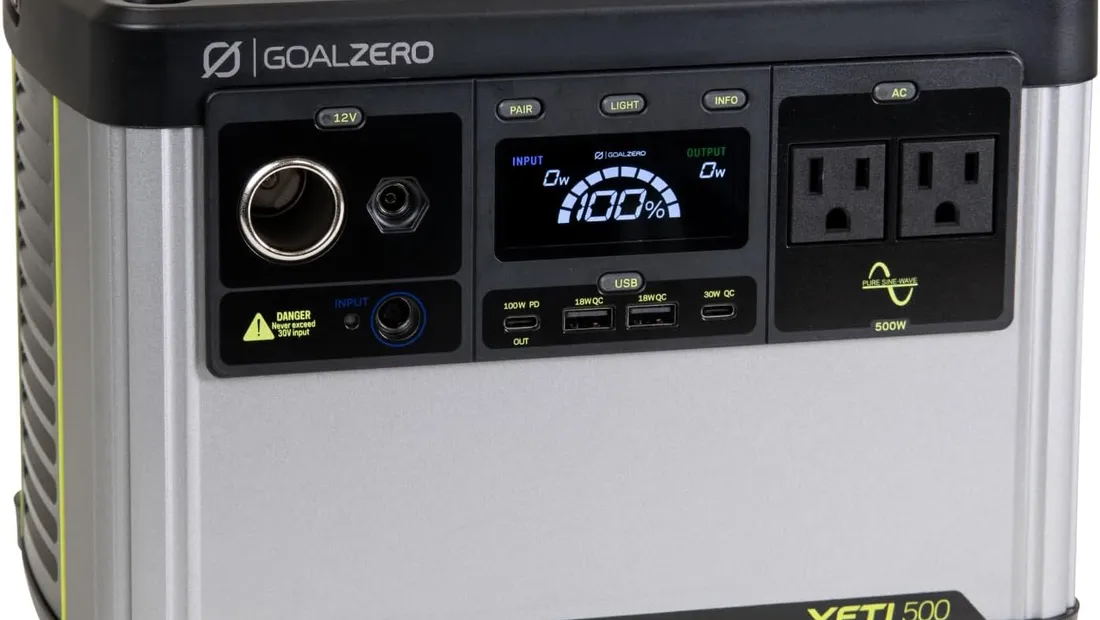
Review status: Enriched with verified Amazon buyer data.
User-reported runtime (verified Amazon buyers)
Two verified Amazon purchasers reported CPAP-specific use of the Goal Zero Yeti 500X:
| Buyer | Use Case | Result |
|---|---|---|
| Dec 2025 (5★) | CPAP user | ”Works well for my CPAP.” Short, unambiguous. |
| Nov 2024 (4★) | CPAP, replacing worn Yeti 400 | ”According to the app, it should power my CPAP for three nights.” Bought specifically for CPAP after two previous Yeti 400s wore out. |
The November 2024 buyer is a long-term Goal Zero user who specifically moved up from the Yeti 400, citing significantly lighter weight as the main reason for the 500X. The 3-night estimate from the Goal Zero app is consistent with our own math: 505Wh ÷ 168 Wh/night (mid-pressure, no humidifier) = 3 nights.
Goal Zero app integration: Unlike most competitors, the Yeti 500X app provides a CPAP-specific runtime estimate based on the machine’s rated wattage. This is a useful feature if you want guidance without doing the math yourself.
Source: Amazon.com verified purchase reviews, B0CRDBGN2N, collected May 2026.
Quick verdict
The Goal Zero Yeti 500X is a smaller, lighter unit from a brand that built its reputation in the outdoor-power space before Jackery and EcoFlow showed up. For CPAP users, it’s a one-night travel battery — not a home backup. If you want a recognizable name and a 12-13 lb unit you can throw in a trunk, it works. If you need humidifier runtime, it doesn’t.
Key specs at a glance:
- 505 Wh capacity — about half the Jackery 1000 / Delta 2 class
- 300W pure sine wave AC continuous (1200W surge) — CPAP-friendly, humidifier-marginal
- Lithium-ion NMC battery — ~500 cycles to 80% (similar profile to Jackery 1000)
- 12.9 lbs (5.85 kg) — genuinely portable for car trips
- USB-C Power Delivery (60W) — useful for laptops and phones in addition to CPAP
- MSRP $699 — frequently $499-599 on Amazon
CPAP-specific considerations
Inverter quality: Pure sine wave, 300W continuous. That’s enough for any standard CPAP (typical draw 30-60W), but the margin shrinks fast once a heated humidifier and heated tubing pile on.
Estimated overnight runtime (calculated from specs):
| CPAP setup | Estimated hours per full charge |
|---|---|
| CPAP only, pressure 8-12 cmH₂O | 11-14 hours (1 night, comfortable) |
| CPAP + heated humidifier (low) | 4-5 hours (won’t cover a full night) |
| CPAP + heated humidifier (high) | 3-4 hours (don’t try) |
Humidifier reality: Skip it on this unit. At ~80W heater draw, 505Wh ÷ 95W ≈ 5.3 hours best case, and that’s before inverter losses. If you want humidifier runtime, look at the Bluetti AC180 or Delta 2 instead — both nearly double the capacity and absorb surges better.
Travel angle: At 12.9 lbs, this is one of the lighter units that can still run a CPAP from AC. It’s still well over the 100Wh airline carry-on limit, so this is a car/RV battery, not a flight battery. For flights, the Medistrom Pilot-24 Lite is the only category that complies.
Where the Goal Zero Yeti 500X shines
- Weight — 12.9 lbs is meaningfully easier to handle than the 22-27 lb units
- USB-C PD — charges your laptop or phone without dragging out a separate brick
- Brand reputation — Goal Zero has a long track record with overlanders and outdoor pros
- Build quality — case feels more rugged than equivalent Jackery models
- App support (Yeti app) — view runtime estimates and toggle ports remotely
Where it falls short
- NMC chemistry — 500-cycle rating means it’s not a great nightly-use battery
- 300W continuous — fine for CPAP alone, but not enough margin for confident humidifier use
- Price-per-Wh — at $699 MSRP, you’re paying ~$1.38/Wh vs the Delta 2’s ~$0.55-0.97/Wh
- No LFP option in this size from Goal Zero — competitors have moved to LFP and they haven’t (in this model)
- Slow charging vs Delta 2 / AC180 fast-charge units
Who should buy this
- Travelers who want a lighter unit and don’t run a humidifier
- Buyers who already own Goal Zero solar panels and want ecosystem fit
- Car campers needing one no-humidifier night
- USB-C laptop users who want one device for CPAP + work backup
Who should skip
- Anyone running a heated humidifier — go bigger (AC180, Delta 2, Jackery 1000)
- Nightly cyclers — NMC will degrade faster than LFP alternatives
- Value buyers — the price-per-Wh is the worst in this lineup
Buy
Check current price on Amazon →
Affiliate disclosure: We may earn a commission from qualifying purchases at no extra cost to you.