Jackery Explorer 500 Review for CPAP Use
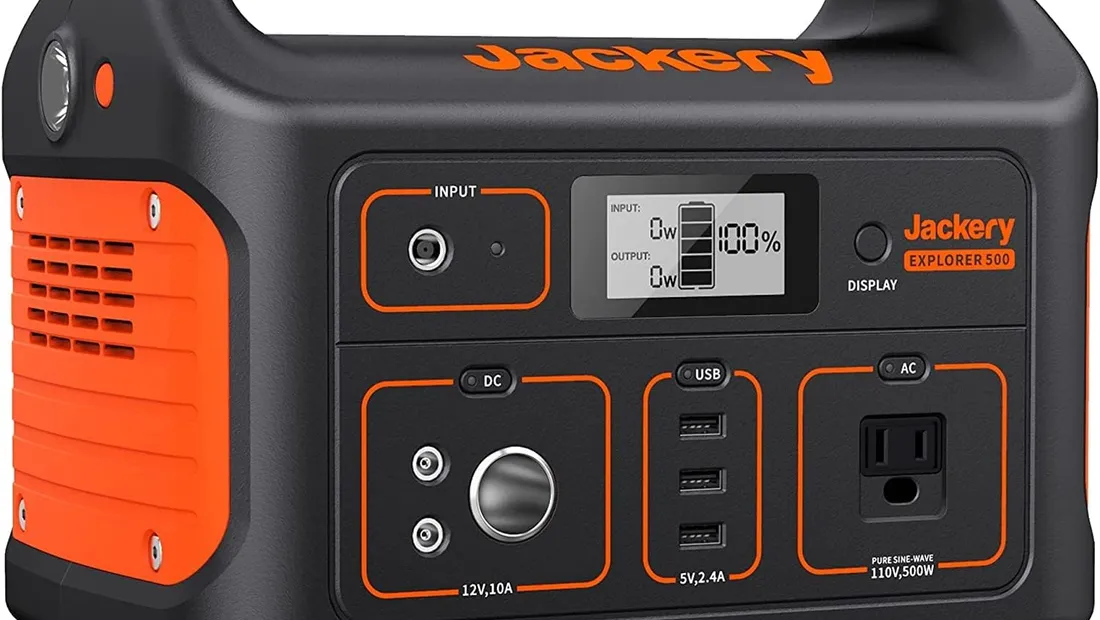
Review status: Enriched with verified Amazon buyer data. Six CPAP-specific verified purchase reviews — the most of any product in our dataset.
User-reported runtime (verified Amazon buyers)
The Jackery Explorer 500 has the most CPAP-specific buyer data of any product we reviewed. Six verified purchasers reported real runtime results:
| Buyer | CPAP Model | Humidifier | Method | Runtime |
|---|---|---|---|---|
| Dec 2024 (5★) | Philips Dreamstation 2, pressure 14 | Level 2/5, heated tube | DC cable | 83% remaining after 7h → ~88 Wh total |
| Apr 2021 (5★) | Unspecified | On | AC | 10% remaining after full night → ~466 Wh |
| Dec 2020 (5★) | ResMed AirSense 10 | On (heated) | AC | 2 nights per charge |
| Dec 2020 (5★) | ResMed AirSense 10 | Off | AC | 4 nights per charge |
| May 2021 (5★) | ResMed AirMini | Off | AC adapter | 6 nights per charge |
| Jul 2022 (5★) | ResMed AirMini | Off | DC cable | 91% remaining after 8h → ~47 Wh/night |
Key finding: DC power vs AC is a 5–10× runtime difference. The AirMini on DC cable used only 47 Wh in 8 hours; a standard CPAP with humidifier via AC used 466 Wh in the same period. If your CPAP supports DC input, the cable pays for itself immediately.
Source: Amazon.com verified purchase reviews, B07SM5HBK1, collected May 2026.
Quick verdict
The Jackery Explorer 500 is the entry point into Jackery’s lineup and the lowest-stakes way to add CPAP backup if you don’t run a humidifier. It’s roughly the same capacity tier as the Goal Zero Yeti 500X, slightly cheaper, slightly lighter, and from a more mainstream brand. For first-time buyers who want one comfortable no-humidifier night, this is the easy pick.
Key specs at a glance:
- 518 Wh capacity — entry-level; comparable to Goal Zero Yeti 500X (505 Wh)
- 500W pure sine wave AC (1000W surge) — handles CPAPs and small electronics
- Lithium-ion NMC battery — ~500 cycles to 80% (older chemistry; the Jackery Explorer 1000 v2 has since moved to LFP)
- 13.3 lbs (6 kg) — easy to carry to the car or campsite
- MSRP $499 — frequently $299-399 on Amazon
CPAP-specific considerations
Inverter quality: Pure sine wave, 500W continuous. CPAP-friendly. The 1000W surge ceiling is enough for compressor startup but doesn’t leave much headroom for a heated humidifier under load.
Estimated overnight runtime (calculated from specs):
| CPAP setup | Estimated hours per full charge |
|---|---|
| CPAP only, pressure 8-12 cmH₂O | 11-14 hours (1 night, comfortable) |
| CPAP + heated humidifier (low) | 4-5 hours (won’t last a full night) |
| CPAP + heated humidifier (high) | 3-4 hours (don’t try) |
Humidifier reality: Skip it. 518Wh against a ~110W combined draw nets roughly 4-4.5 hours after inverter losses. Same story as the Yeti 500X — at this capacity tier, humidifier runtime isn’t realistic. For humidifier-on overnight, step up to the EcoFlow River 2 Pro (768Wh, LFP) or one of the 1000Wh-class units.
Travel angle: 13.3 lbs is the lightest AC unit in this guide. It’s still well over the 100Wh airline carry-on limit, so it’s a car/RV battery — not a flight battery. For flying, see the Medistrom Pilot-24 Lite.
Where the Jackery Explorer 500 shines
- Lightest AC unit in this guide at 13.3 lbs
- Brand familiarity — Jackery is the easiest portable-power brand to source at retail
- Solar input — pairs with Jackery SolarSaga panels for off-grid recharge
- Simple UX — buttons, an LCD, no app required
- Pass-through charging — runs CPAP while charging from wall
Where it falls short
- NMC chemistry — 500-cycle rating means rapid capacity loss for nightly users
- No humidifier runtime — capacity is the bottleneck, not the inverter
- Slow recharge — ~7.5 hours from wall, no fast-charge mode
- Older design — the Jackery 300/500 line predates the LFP wave that hit the segment in 2022-2023
Who should buy this
- First-time buyers who want a lightweight, no-humidifier CPAP travel battery
- Car campers and weekend trip-takers
- Buyers prioritizing brand familiarity over chemistry/cycle-life specs
- Anyone who already owns Jackery solar panels
Who should skip
- Heated-humidifier users — the capacity is too small, full stop
- Nightly cyclers — NMC degrades faster than LFP units like the EcoFlow River 2 Pro
- Value buyers comparing $/Wh — the River 2 Pro often beats this on sale and gets you LFP
Buy
Check current price on Amazon →
Affiliate disclosure: We may earn a commission from qualifying purchases at no extra cost to you.