Off-Grid CPAP Setup: Van Life, RV, and Boondocking Power Solutions
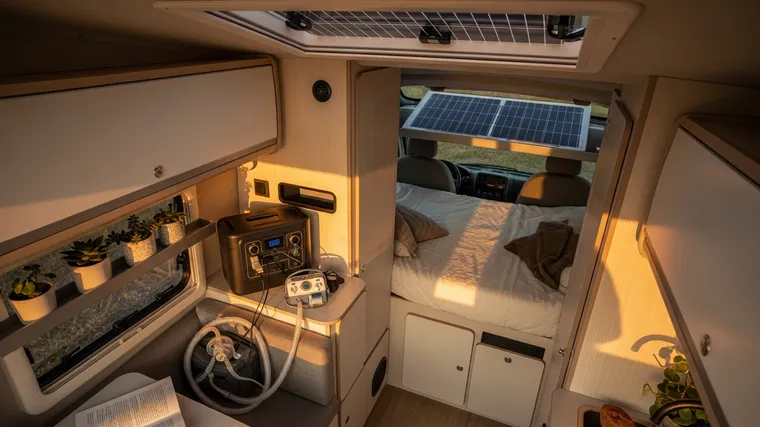
The off-grid CPAP problem
A CPAP needs roughly 30-60 Wh per night without humidifier, 200-800 Wh with humidifier depending on settings. That’s trivial in a house. It becomes the central design constraint when you’re powering everything from a van roof, an RV battery bank, or a generator.
This guide covers the three real off-grid scenarios — short camping trips, RV/van full-time, and remote boondocking — and what power setup actually works for each.
Quick sizing math
Start with your overnight Wh draw. The honest version:
| CPAP setup | Per night | Per week | Per month |
|---|---|---|---|
| CPAP only, AirSense 11 at 8 cmH₂O | 50 Wh | 350 Wh | 1500 Wh |
| CPAP + humidifier, low setting | 250 Wh | 1750 Wh | 7500 Wh |
| CPAP + humidifier, high in cold | 700 Wh | 4900 Wh | 21,000 Wh |
| BiPAP + humidifier, average | 500 Wh | 3500 Wh | 15,000 Wh |
Multiply by 1.2 to account for inverter conversion losses (DC battery → AC for the CPAP → DC inside the CPAP). That’s your actual battery draw per night.
Now figure out your recharge source: solar, alternator, generator, or shore power.
Scenario 1: Weekend camping (2-3 nights)
Simplest case. Charge a power station at home, take it with you, run the CPAP overnight.
Sizing:
- 2 nights without humidifier: 100-150 Wh used → any EcoFlow River 2 Pro (768Wh) handles it with massive margin
- 2 nights with humidifier on low: 500-700 Wh used → EcoFlow Delta 2 (1024Wh) is the safe pick
- 3 nights with humidifier: 750-1000 Wh used → Bluetti AC180 (1152Wh) or larger
Charging: Skip solar for short trips. Just charge fully at home before you leave. If the trip extends, a 100W folding solar panel adds 300-500 Wh per sunny day — enough to extend by one extra night.
Scenario 2: Van life or RV (continuous off-grid use)
Full-time van life or extended RV boondocking is where the math gets serious. You’re recharging continuously and the daily energy budget has to balance.
Daily energy in vs. out (typical van life, CPAP without humidifier):
| Source / load | Wh per day |
|---|---|
| 200W roof solar, 5 effective sun-hours | +1000 |
| Alternator while driving (3 hours, 100W avg) | +300 |
| Daily input | +1300 |
| CPAP overnight | -60 |
| Lights, USB charging, fans | -100 |
| Fridge (12V compressor) | -500 |
| Laptop, phone, misc | -200 |
| Daily load | -860 |
The CPAP is a small slice of daily van life electrical demand. The bigger items are the fridge and the laptop. Add a humidifier and you suddenly need 250+ extra Wh per day, which is roughly equivalent to adding a second fridge.
Recommended battery bank for continuous van life:
- Single user, no humidifier: 1000-1500 Wh battery, 200W solar
- Single user with humidifier: 2000-3000 Wh battery, 300-400W solar
- Couple, both on CPAP: 3000+ Wh battery, 400W+ solar
- Couple with humidifiers in cold weather: 4000+ Wh battery, 600W solar, plus alternator charging
For van conversions, EcoFlow Delta 2 is a popular drop-in. For more permanent installs, the Bluetti AC200Max (2048Wh, expandable to 8192Wh with B230 batteries) is the right scale. Full-time couples or those running A/C should look at the EcoFlow Delta Pro 3 (4096Wh, expandable to 48kWh).
Scenario 3: Multi-night boondocking (no recharge for days)
You drive to a remote spot, park, and don’t run the engine for 4-7 days. The battery has to hold all the energy you’ll use.
Energy budget for 5 nights, CPAP-only:
- 5 × 60 Wh × 1.2 inverter loss = 360 Wh just for CPAP
- Fridge (~500 Wh/day × 5) = 2500 Wh
- Lights, charging, misc = 1000 Wh
- Total: ~3860 Wh
A 1024Wh EcoFlow Delta 2 won’t make it without solar input. A 2048Wh Bluetti AC200Max barely survives. The realistic answer is the EcoFlow Delta Pro 3 (4096Wh) plus 200W of solar for daytime top-up.
With humidifier on low (250 Wh/night × 5 = 1250 Wh just for CPAP), the math doubles. You’re now in 5000-6000 Wh territory for a 5-day boondock with humidified CPAP. That’s a real RV solar setup, not a portable power station.
Solar panel sizing reference
Solar input depends on panel wattage, sun angle, and weather. Realistic output in good conditions:
| Panel | Best case | Typical day | Cloudy day |
|---|---|---|---|
| 100W rigid | 500 Wh | 350 Wh | 100 Wh |
| 200W rigid | 1000 Wh | 700 Wh | 200 Wh |
| 400W roof array | 2000 Wh | 1400 Wh | 400 Wh |
| 100W folding portable | 400 Wh | 250 Wh | 80 Wh |
Folding portable panels are less efficient than rigid roof-mounted ones because they sit at a poor angle and run hot.
The cloudy-day rule: size for the worst day you’ll camp through, not the best. A 200W array averages 700 Wh on a typical day but only 200 Wh under heavy clouds. If your CPAP+humidifier eats 250 Wh/night, you’ll go negative on cloudy stretches.
Pure sine wave check (RV factory inverters)
Many factory RV inverters are modified sine wave, especially older Class C and travel trailer setups. CPAP manufacturers explicitly warn against modified sine wave — it can cause humming, occasional shutdowns, and accelerated power-supply wear.
Before plugging your CPAP into a built-in RV inverter, verify pure sine wave. If it’s modified sine wave, either:
- Use a portable power station with pure sine wave (EcoFlow, Jackery, Bluetti — all pure sine wave) plugged into the RV’s outlets
- Replace the RV’s inverter with a pure sine wave model (Victron, Renogy, Go Power)
- Run the CPAP off a CPAP-specific battery (Medistrom Pilot-24 Lite) that has its own DC-to-DC conversion
Generator backup for extended cloudy weather
If you boondock in places with multi-day cloudy stretches (Pacific Northwest, mountain valleys), a small inverter generator (Honda EU2200i, Yamaha EF2000iSv2) can recharge your power station in 1-2 hours. The generator runs once a day, the power station runs the CPAP.
This is also the answer for winter boondocking: solar yield drops 50-70% in winter, generator becomes the primary recharge source, and the battery bank covers overnight CPAP plus next-morning needs.
Cross-reference: common product picks
- EcoFlow Delta 2 — best general-purpose van life CPAP battery; LFP, 200W solar input, 1024Wh
- Jackery Explorer 1000 — 1070Wh LFP, 1-hour fast charge, strong daily-cycle option
- Bluetti AC180 — 1152Wh LFP, good middle-ground
- Goal Zero Yeti 500X — well-built but expensive per Wh
- Medistrom Pilot-24 Lite — for ultra-portable backup, not main off-grid power
The honest summary
Off-grid CPAP comes down to one number: how much energy do you use per night, and can your recharge source replace it the next day. Without humidifier, almost any 1000Wh power station with 100-200W of solar will keep up indefinitely. With humidifier on high in cold weather, you’re in serious solar-array-and-second-battery territory.
If you’re planning van life with CPAP, disable the humidifier and use saline spray unless you’re committing to a 3000+ Wh battery and 400W of solar. The math doesn’t lie.
Affiliate disclosure: When you buy through links on this site, we may earn a commission at no extra cost to you.
Frequently Asked Questions
How much solar do I need to recharge a CPAP battery?
For a CPAP without humidifier (40-60 Wh per night), a 100W panel in good sun adds 300-500 Wh per day — comfortable margin. For CPAP with humidifier on low (200-300 Wh per night), step up to 200W. With humidifier on high in cold weather (500-800 Wh per night), 400W of solar is the realistic minimum, and even then you're vulnerable to cloudy days.
Can I just plug my CPAP into the RV house battery?
If the RV has a pure sine wave inverter and the house battery is sized for it, yes. The catch: many factory RV inverters are modified sine wave (CPAP manufacturers warn against this). Confirm pure sine wave first. The other catch: house batteries on most factory RVs are only 80-100Ah (about 1000-1200 Wh usable on lead-acid), which the CPAP will share with the fridge, lights, and water pump.
What's the best portable power station for van life with CPAP?
For one-person van life, the EcoFlow Delta 2 (1024Wh, LFP, 200W solar input) handles 1-2 nights with humidifier or 4-5 nights without. For two CPAPs or longer boondocking, the Bluetti AC200Max (2048Wh) doubles your runtime. Full-time van life with humidifier and frequent boondocking deserves the EcoFlow Delta Pro 3 (4096Wh expandable).
Will a 100W solar panel keep up with overnight CPAP use?
If you skip the humidifier, yes — 100W of solar in 5 hours of decent sun gives you 400-500 Wh, which covers one CPAP-only night plus margin. Add humidifier and you'll fall behind on cloudy days. The real-world rule: budget 2x your overnight Wh need in solar capacity to cover bad weather.
What's the difference between shore power and full off-grid?
Shore power means you're plugged into a 30A or 50A campsite connection, which essentially gives you unlimited household-style power — no battery sizing needed, run the humidifier on high. Full off-grid (boondocking) means no external power: you run on stored battery, recharged by solar, alternator, or generator. The CPAP sizing math only matters when you're off-grid.
Can I charge the power station from my van's alternator while driving?
Yes — most modern portable power stations accept 12V DC input via car cigarette plug or DC-to-DC charger. Expect 80-150W of charging while driving. A 4-hour drive will add 400-500 Wh to a EcoFlow Delta 2. For serious van life, install a dedicated DC-to-DC charger (Renogy, Victron) that can deliver 30-50A through proper wiring — that's 360-600W of recharge while you drive.