Humidifier on Battery: The Math, Tradeoffs, and Workarounds
The brutal math
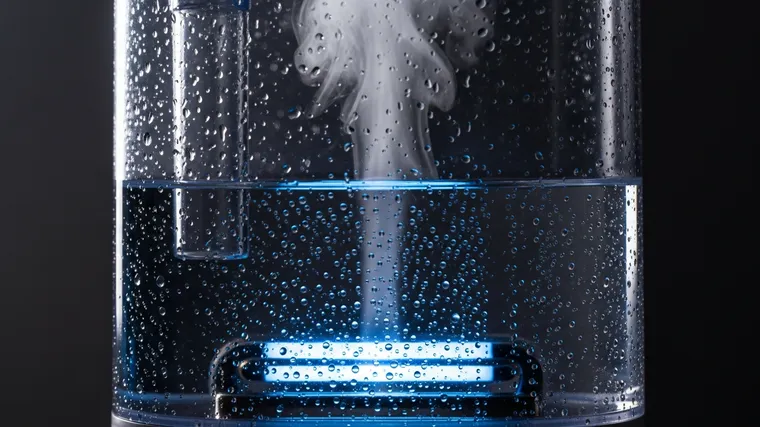
CPAP humidifier numbers are surprising the first time you see them. The CPAP itself — the blower, the electronics, the small fan — uses roughly the same power as a 5-watt USB phone charger. The heated humidifier is essentially a small space heater. It heats water to produce steam, and heating water takes a lot of energy.
Here’s the core comparison for one night (8 hours) of therapy:
| Setup | Continuous draw | Per night |
|---|---|---|
| CPAP only | 5 W | 40 Wh |
| CPAP + humidifier (passover, no heat) | 7 W | 56 Wh |
| CPAP + humidifier (heat on low, warm room) | 28 W | 224 Wh |
| CPAP + humidifier (heat medium, average room) | 45 W | 360 Wh |
| CPAP + humidifier (heat high, cold room) | 75 W | 600 Wh |
| CPAP + humidifier high + heated tube + cold | 95 W | 760 Wh |
The high-end of that table is 19x more power than CPAP alone. Your battery has to be 19x larger to last the same number of nights — or you accept that the humidifier transforms a one-week battery trip into a two-night one.
Why heat costs so much energy
Water is incredibly energy-dense to heat. The thermodynamic floor is roughly 4.2 kJ to raise 1 liter of water by 1°C. A CPAP humidifier doesn’t boil the water (it would shoot steam at your face), but it maintains a warm reservoir at maybe 30-40°C and uses ambient airflow to evaporate water across the surface.
The heating element runs on duty cycle: it kicks on when the chamber temperature drops, kicks off when it hits target. Average power depends entirely on how fast the chamber loses heat to ambient air. A warm room (24°C/75°F) loses heat slowly — element is on maybe 30% of the time. A cold room (16°C/61°F) loses heat fast — element runs 80%+ of the time.
This is why a measurement done in summer at home (35W average) becomes 75W in a winter cabin. Same humidifier, same setting, double the load.
Climate-line / heated tube: helpful but extra draw
Heated tubes (ResMed Climate Line, Philips Heated Tube) prevent condensation buildup (“rainout”) that drips back through the hose into the mask. They’re a real comfort upgrade in cold rooms.
But they add another 5-15W of continuous draw on top of the humidifier. The combined total — humidifier + heated tube — runs 70-100W continuously in cold conditions.
The honest tradeoff: a heated tube lets you run the humidifier itself on a lower setting (because rainout isn’t pulling moisture out as fast), so you can sometimes net out about even on total power. Sometimes. In very cold rooms, both at high settings is just additive.
Room temperature: the variable nobody mentions
The CPAP power station marketing assumes you’re sleeping in a 22°C/72°F room. Your real overnight draw will be:
- Warm room (24-26°C / 75-79°F): Humidifier cycles infrequently. Real draw 25-35W on medium.
- Average room (20-22°C / 68-72°F): Humidifier cycles regularly. Real draw 40-55W on medium.
- Cold room (15-18°C / 59-64°F): Humidifier runs nearly continuously. Real draw 65-90W on medium.
- Very cold (below 12°C / 54°F): Humidifier maxed out, may not maintain target temp. 90-120W on high.
For travel scenarios, consider where you’ll actually sleep:
- Hotel rooms in summer: warm, humidifier light load
- Cabin in fall: cold at night, humidifier heavy load
- Tent camping: very cold, humidifier won’t keep up and drains battery fast
- RV in winter: depends on heating; cold RV = battery killer
When the humidifier is worth the runtime cost
Some users genuinely can’t tolerate dry air for therapy. Reasons it might be worth carrying a 2000+ Wh battery:
- Severe nasal symptoms without humidification: nosebleeds, sinus pain, painful dryness
- Recovery from sinus surgery or chronic sinusitis
- Pre-existing dry mucous membranes or autoimmune dryness conditions (Sjögren’s, etc.)
- Living in a permanently dry climate (Arizona, high desert) where ambient humidity is below 20%
For these users, the humidifier isn’t a convenience — it’s part of effective therapy. Battery sizing should accept the 4-8x multiplier and budget accordingly.
Workarounds: dry-air strategies that actually work
Most travel and emergency-backup users don’t fall into the medical-necessity category above. The humidifier is comfort, not therapy. Here’s what works instead:
1. Saline nasal spray — A simple bottle of saline (Ayr, Simply Saline, Ocean) used before bed and on waking handles 80% of dryness for most users. Cheap, TSA-legal, weighs nothing.
2. AC room humidifier on shore power — When you’re at a hotel or cabin with wall power available, plug a $30 ultrasonic room humidifier into the wall, leave the CPAP humidifier off and run it on battery. The room humidifier raises ambient moisture to the point that the CPAP doesn’t need its own.
3. Passover (unheated) humidification — Keep water in the humidifier chamber, disable just the heating element. The airflow picks up some moisture passively. Minimal extra power (1-2W). Helpful for travel.
4. Hydrate aggressively during the day — Counterintuitive but real. Well-hydrated mucous membranes tolerate dry-air therapy much better than dehydrated ones. Drink water during the day, not late evening (which causes nighttime bathroom trips that interrupt therapy).
5. Mask choice matters — Full-face masks lose more moisture than nasal pillows, because you’re breathing through your mouth. If you tolerate nasal pillows, dryness drops significantly even without humidifier.
6. Climate change at the destination — A weekend in Florida summer (high ambient humidity) means you don’t need humidifier anyway. A weekend in Colorado winter (very dry) means budget for max humidifier or accept dryness.
Battery sizing for humidifier users
If you’ve decided the humidifier comes with you, here’s the realistic battery math:
| Use case | Humidifier setting | Per night need | Recommended battery |
|---|---|---|---|
| Hotel, warm climate | Low | 200 Wh | 500 Wh (Jackery Explorer 500) |
| Hotel, average climate | Medium | 350 Wh | 800 Wh (EcoFlow River 2 Pro) |
| RV, mixed climate | Medium | 400 Wh | 1000 Wh (EcoFlow Delta 2) |
| Cabin, cold weather | High | 600 Wh | 1500 Wh (Bluetti AC180) |
| Multi-night cold camping | High | 700 Wh × N nights | 2000+ Wh (Bluetti AC200Max) |
Multiply per-night need by 1.2 for inverter loss. The rightmost column is the realistic battery size for that use case — not the absolute minimum.
Why surge headroom matters
The humidifier creates surge spikes when the heating element first kicks on and during cold-room cycle peaks. These can hit 100-150W for 10-30 seconds. Power stations rated at only 200W continuous AC output may trip on these surges, cutting power to your CPAP mid-night.
For humidifier users, look for power stations with:
- Continuous AC output ≥ 300W
- Surge rating ≥ 600W
- Pure sine wave (always)
The EcoFlow Delta 2 (1800W continuous, 2700W surge) handles humidifier spikes with massive headroom. The Jackery Explorer 1000 (1000W continuous, 2000W surge) is also fine. Avoid sub-300W stations for humidifier use.
The honest summary
Heated humidification is the single biggest factor in CPAP battery sizing — it can multiply your overnight energy need by 4-15x depending on settings and room temperature. Most travel users disable the heater on battery and use saline spray plus aggressive daytime hydration; the few who genuinely need humidified air should budget for a 1500-2000+ Wh power station with strong surge headroom.
If you’re sizing your first power station, try one trip without the humidifier before committing to a 2000Wh battery you’ll lug around for years. You may find you don’t miss it.
Affiliate disclosure: When you buy through links on this site, we may earn a commission at no extra cost to you.
Frequently Asked Questions
How much extra power does a heated humidifier use?
A CPAP without humidifier draws 4-7 watts continuous. Add the heated humidifier on low and you're at 25-35 watts — 5-7x more power. On high in a cold room, the humidifier pushes total draw to 60-90 watts, roughly 10-15x more than CPAP alone. The heating element is the single largest power consumer in a CPAP setup.
Will my battery last all night with humidifier on high?
Depends on battery size. A 500 Wh power station running CPAP + humidifier on high (75W average) lasts about 5-6 hours — not a full 8-hour night. A 1000 Wh station ([EcoFlow Delta 2](/products/ecoflow-delta-2/), [Jackery Explorer 1000](/products/jackery-explorer-1000/)) handles one full night with margin. For multiple nights with humidifier high, you need 2000+ Wh.
What's a climate-line / heated tube and does it use more power?
A climate-line (ResMed) or heated tube prevents condensation by warming the air after it leaves the humidifier. It adds another 5-15W of continuous draw on top of the humidifier. So CPAP + humidifier + heated tube together can pull 70-100W continuously. The benefit: you can run humidifier on lower settings without rainout, which usually nets out about even on power.
Can I run the humidifier without the heater on?
Yes — passover humidification (water in the chamber, no heating) adds slight moisture to the airflow without the power penalty. Most modern CPAPs let you disable just the heating element while keeping the water chamber. You get 10-20% humidity boost vs. dry, and only add 1-2W to the CPAP's draw. For battery use, this is a strong middle ground.
Why does my humidifier seem to use less power on warmer nights?
The heated humidifier targets a specific output temperature. In a warm room, it doesn't have to work as hard — the heating element cycles on briefly, then off for longer periods. In a cold room, the element runs nearly continuously to maintain target temp. The same humidifier setting can use 30W in summer and 70W in winter. This is why off-grid winter CPAP needs much bigger batteries.
What are alternatives to a heated humidifier on battery?
Several work well: (1) saline nasal spray before bed and on waking, (2) a small AC-powered room humidifier running on shore power while the CPAP runs on battery, (3) accept slightly drier air for the trip — most travelers tolerate 2-5 nights without humidifier fine, (4) use passover (unheated) humidification only, (5) hydrate well during the day. Most experienced travel users disable the heater entirely on battery.