ResMed AirSense 11 Battery Backup: How to Power It When the Grid Goes Down
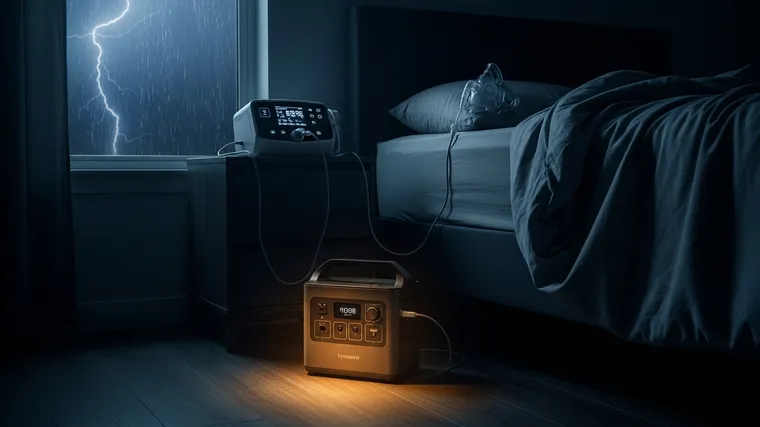
The ResMed AirSense 11 is the most widely prescribed CPAP in the world. It’s also a 24V device with a HumidAir integrated humidifier and ClimateLineAir heated tube — meaning it can draw anywhere from 15W to 70W depending on settings. Getting the battery math wrong means waking up mid-outage.
What the AirSense 11 Actually Draws
The nameplate on the AC adapter says “90W max.” Ignore that number for battery sizing — it’s the maximum the adapter can supply, not the typical draw.
Real operating wattage by mode:
| Mode | Approximate Draw | Wh per 8-hour night |
|---|---|---|
| Therapy only (no humidifier) | 15–20W | 120–160 Wh |
| HumidAir on mid setting (3/5) | 25–40W | 200–320 Wh |
| HumidAir + ClimateLineAir, cold room | 50–70W | 400–560 Wh |
Verified buyer data point: One Amazon reviewer running an AirSense 11 for 7 hours 45 minutes via AC measured 37% battery used on a 768Wh EcoFlow River 2 Pro — that’s 284Wh consumed, or about 37W average. This is consistent with HumidAir on a mid setting.
Power Options for the AirSense 11
Option 1: AC Power Station (Any Pure Sine Wave Unit)
Plug the standard AirSense 11 power brick into any power station’s AC outlet. Requires pure sine wave output — all major brands (Jackery, EcoFlow, Bluetti, Goal Zero) qualify.
Pros: works with any power station, no extra cables needed
Cons: 15–25% inverter loss, heavier power station needed
Minimum size for one night: 400Wh usable capacity. That covers mid-setting humidifier at 284Wh plus a safety margin.
Option 2: 24V DC Direct Connection
The AirSense 11 has a dedicated DC input that accepts 24V. ResMed sells a 24V DC cable; third-party options exist. Most power stations don’t provide 24V natively — you’d use the Medistrom Pilot-24 Lite or a 24V-compatible battery.
Pros: 30–50% better runtime, no inverter heat
Cons: requires specific cable and compatible power station
Option 3: Medistrom Pilot-24 Lite (CPAP-Specific)
Purpose-built for the AirSense 11. Provides 24V DC directly, 95Wh capacity, TSA carry-on legal.
Pros: airline travel compatible, plug-and-play
Cons: single night, no AC output, $249 price point
See our Medistrom Pilot-24 Lite review for full detail.
Sizing for Home Power Outages
Power outages in the US average 8+ hours annually (EIA data), with hurricane-prone regions seeing multi-day events regularly.
| Scenario | What You Need |
|---|---|
| Single overnight outage, no humidifier | 200Wh minimum (Medistrom, Jackery 500) |
| Single overnight, HumidAir mid setting | 400Wh minimum (Jackery 500, EcoFlow River 2 Pro) |
| 2-day outage, HumidAir mid setting | 800Wh+ (EcoFlow River 2 Pro, EcoFlow Delta 2) |
| Multi-day outage with humidifier | 1000Wh+ (Jackery Explorer 1000 v2, Bluetti AC180, EcoFlow Delta 2) |
The HumidAir Trade-Off
Turning off the HumidAir humidifier is the single biggest way to extend battery life on the AirSense 11. In our buyer data for the Jackery Explorer 500:
- With humidifier: 2 nights per charge
- Without humidifier: 4 nights per charge
The AirSense 11’s “Climate Control Auto” setting will try to maintain humidity even on battery. To preserve battery life, switch to “Humidifier Mode: Manual” and reduce the humidity setting, or disable it entirely for short outages.
Our Picks for AirSense 11 Backup
| Use Case | Pick | Why |
|---|---|---|
| Air travel | Medistrom Pilot-24 Lite | Only FAA carry-on legal option |
| 1–2 nights, moderate budget | EcoFlow River 2 Pro | 768Wh LFP, verified 2–3 nights with AirSense |
| 2–3 nights or house with humidifier | Jackery Explorer 1000 v2 | 1070Wh LFP, one user reported 3+ nights at high pressure |
| Hurricane-prone household | Bluetti AC180 | 1152Wh LFP, UPS-mode supports seamless failover |
Frequently Asked Questions
What battery works with the ResMed AirSense 11?
The AirSense 11 accepts a ResMed-brand 24V DC power supply (sold separately) that connects directly to compatible batteries like the Medistrom Pilot-24 Lite or via any power station with a 12V or AC output. Using 24V DC directly is the most efficient; using AC through a power station adds 15–25% inverter loss but works with any pure sine wave unit.
How many watt-hours does the ResMed AirSense 11 use per night?
Based on a verified buyer review, an AirSense 11 running for 7h 45m consumed 284Wh — about 37W average draw. Without the HumidAir heated humidifier, draw typically falls to 15–25W (120–200 Wh/night). With HumidAir on maximum in a cold room, draw can reach 50–70W.
Can the ResMed AirSense 11 run on DC power from a battery?
Yes, with the ResMed 24V Power Station Cable or compatible third-party 24V DC adapter. Running DC bypasses the AC inverter in the power station and adds significant runtime — often 30–50% more than using the standard AC power brick.
How many nights will a 1000Wh battery power an AirSense 11?
At the verified buyer-reported rate of 284Wh per night (via AC), a 1000Wh-class power station (actual ~820Wh usable after efficiency loss) would run an AirSense 11 for roughly 2.9 nights. Via DC, expect 4+ nights.
Is the ResMed AirSense 11 compatible with the Medistrom Pilot-24 Lite?
Yes. The Medistrom Pilot-24 Lite provides 24V DC output that matches the AirSense 11's native voltage. Runtime is approximately 1 night without humidifier. It's also TSA/FAA carry-on compliant at 95Wh, unlike most power stations.