How Many Watts Does a CPAP Use? Complete Power Guide (2026)
Why this matters
Most CPAP power calculations done online are wrong. They use the nameplate wattage from the AC adapter (often 90W or 100W), multiply by 8 hours of sleep, and tell you that you need a 720 Wh battery for one night. That’s a 10-20x overestimate.
Knowing your real draw — the continuous wattage during normal operation, not the maximum rating — is the difference between buying a 500Wh battery that does the job and an unnecessary 2000Wh unit you’ll lug around for years. This guide shows you how to read the spec, what the numbers actually mean, and how to measure your specific machine.
Reading the spec label
Flip your CPAP machine over (or look at the AC adapter brick). You’ll see something like:
INPUT:  100-240V AC, 50/60Hz, 1.0A
OUTPUT: 24V DC, 3.75A, 90W
What each number means:
- 100-240V AC, 50/60Hz: Universal AC input — works on any household current worldwide.
- 1.0A: Maximum current the AC adapter draws from the wall. At 110V, that’s 110W max from the wall. At 220V, the same 1.0A is 220W max. The adapter is sized for worst case.
- 24V DC: The voltage the AC adapter outputs to the CPAP. ResMed = 24V. Older Philips = 12V.
- 3.75A: Maximum current the adapter delivers to the machine.
- 90W: Maximum power consumption (24V × 3.75A = 90W).
The 90W rating is the ceiling the adapter can supply — not what your machine pulls during a typical 8-hour night.
Real draw vs. nameplate
This is the part people miss. A nameplate of 90W means the adapter can supply up to 90W. The CPAP will only pull what it actually needs at any given moment. Here’s the breakdown:
| Operating state | Real continuous draw |
|---|---|
| CPAP alone, low pressure (5-8 cmH₂O) | 4-7 W |
| CPAP alone, high pressure (15-20 cmH₂O) | 8-12 W |
| CPAP + humidifier (low setting, warm room) | 25-35 W |
| CPAP + humidifier (medium, average room) | 35-50 W |
| CPAP + humidifier (high, cold room) | 60-90 W |
| CPAP + humidifier + heated tube (cold) | 70-100 W |
For 8 hours of sleep, multiply continuous draw by 8 to get watt-hours per night. A CPAP-only setup uses 32-56 Wh; a CPAP with humidifier on low uses 200-280 Wh; a CPAP with humidifier on high in a cold room can hit 480-720 Wh.
That last number is roughly 10x the CPAP-only setup. The humidifier is by far the biggest variable in CPAP power consumption.
Voltage: 12V vs 24V vs AC
CPAPs generally use one of three power input schemes:
24V DC (most modern machines):
- ResMed AirSense 11
- ResMed AirSense 10
- ResMed AirCurve
- Philips DreamStation 2
- Most newer Fisher & Paykel machines
12V DC (older/some travel machines):
- Older Philips DreamStation (original)
- Some Transcend machines
- Some F&P SleepStyle units
Direct AC (no DC option):
- ResMed AirMini (sort of — uses a USB-C-style power input internally)
- Most legacy/older 90s-2000s machines
Why this matters for batteries:
- CPAP-specific batteries (Medistrom Pilot, ResMed Power Station II) have to match your CPAP voltage. You can’t use a 12V Pilot-12 with a 24V AirSense 11 — wrong voltage.
- Universal AC power stations (Jackery, EcoFlow, Bluetti, Goal Zero) output 110V AC, and you plug your CPAP’s regular AC adapter into the outlet. The voltage gets sorted out by the AC adapter as usual. No compatibility concerns.
- Direct DC connection (skipping the AC adapter) is more efficient — 10-20% less energy used per night — because you skip the inverter conversion loss. Some power stations have a 12V cigarette outlet or a DC barrel jack, but you’ll need the right cable for your specific CPAP. ResMed sells one for AirSense 10/11.
Common CPAP models: power reference
| Model | Voltage | Adapter rating | Typical real draw (no humidifier) | Typical real draw (humidifier low) |
|---|---|---|---|---|
| ResMed AirSense 11 | 24V DC | 90W | 4-7 W | 25-35 W |
| ResMed AirSense 10 | 24V DC | 90W | 5-8 W | 30-40 W |
| ResMed AirMini | USB-C / 24V | 65W | 4-6 W | N/A (no built-in humidifier) |
| ResMed AirCurve 11 (BiPAP) | 24V DC | 90W | 8-15 W | 40-60 W |
| Philips DreamStation 2 | 24V DC | 80W | 5-8 W | 30-45 W |
| Philips DreamStation (original) | 12V DC | 80W | 6-10 W | 35-50 W |
| Transcend 365 / Auto | 12V DC | 60W | 5-8 W | N/A or low |
| Fisher & Paykel SleepStyle | 24V DC | 100W | 6-10 W | 35-55 W |
These are typical ranges measured in moderate conditions. Your specific machine will vary — pressure setting, mask type, humidifier setting, and room temperature all matter.
How to measure your specific machine
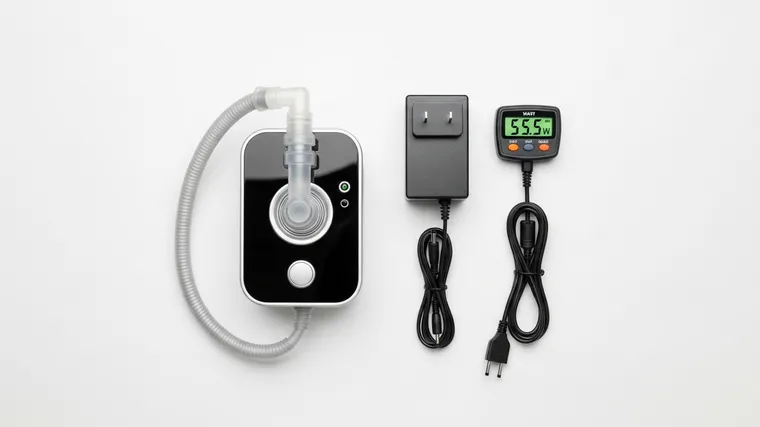
The most reliable way to size a battery is to measure your real overnight draw with a Kill A Watt meter (or any household energy meter that reports kWh).
Steps:
- Plug a Kill A Watt P3 meter (~$25 on Amazon) into a wall outlet
- Plug your CPAP’s AC adapter into the Kill A Watt
- Reset the meter to zero
- Sleep one full night with your normal settings
- Read the kWh value in the morning
Convert kWh to Wh: multiply by 1000. So 0.045 kWh = 45 Wh.
Run this twice:
- Once with humidifier off
- Once with humidifier at your normal setting
Now you have two real numbers for your specific machine, room, and settings. Multiply by 1.2 for inverter loss (assuming you’ll be running on a power station’s AC inverter), and you have your battery size requirement.
Example: A measured 280 Wh per night with humidifier × 1.2 inverter loss = 336 Wh actual battery draw. A 500Wh power station gives you ~1.5 nights. A 1000Wh gives you ~3 nights.
Doing the math without measuring
If you don’t want to measure, use these conservative defaults:
- CPAP only: 60 Wh/night
- CPAP + humidifier low: 280 Wh/night
- CPAP + humidifier high: 700 Wh/night
- BiPAP + humidifier average: 500 Wh/night
Multiply by 1.2 for inverter loss. Multiply by the number of nights you need. That’s your battery size.
Example: Two nights of CPAP-only at 60 Wh × 2 × 1.2 = 144 Wh required. A Medistrom Pilot-24 Lite (95 Wh) gets you most of one night plus a chunk of a second; an EcoFlow River 2 Pro (768 Wh) gets you over a week.
What about the humidifier surge?
When the heated humidifier first kicks on, it pulls a brief surge of 80-100W for 10-30 seconds while the heating element warms up. This usually happens at startup and again periodically as the water cools. Most power stations handle this fine if their continuous AC output is rated at 300W or higher.
If your power station is rated at only 200W continuous (some smaller units), the humidifier surge can occasionally trip the over-current protection. Either step up to a 300W+ unit (EcoFlow Delta 2, Jackery Explorer 1000) or run the humidifier on low.
The summary
The label on your CPAP brick tells you the maximum the adapter can supply. Your real overnight draw is much lower — 4-15W for CPAP only, 25-90W with humidifier. To size a battery, either measure your specific machine with a Kill A Watt or use the typical-draw table, multiply by hours of sleep and 1.2 for inverter loss.
For most users running a modern ResMed or Philips machine without humidifier, a 500Wh power station is overkill for one night. With humidifier on medium, a 1000Wh power station is the realistic minimum. The numbers don’t lie if you measure them.
Affiliate disclosure: When you buy through links on this site, we may earn a commission at no extra cost to you.
Frequently Asked Questions
Where do I find my CPAP's wattage rating?
Check the bottom of the machine or the AC adapter brick. You'll see something like '24V DC, 3.75A' or '90W max'. The key numbers are voltage (V), amperage (A), and watts (W). Watts = Volts × Amps. The label shows maximum draw, not typical — your real overnight average is usually 30-60% of the nameplate rating.
Why does the label say 90W but my CPAP only draws 5W?
The 90W rating is the maximum the AC adapter can supply, sized to handle worst-case scenarios: high pressure, heated humidifier on max, heated tube on cold setting. A typical CPAP at 8 cmH₂O without humidifier uses 4-7W continuous. The full 90W is only consumed during humidifier heat-up cycles or peak humidifier-and-heated-tube operation.
Does CPAP voltage matter for choosing a battery?
Yes, because some batteries (like the Medistrom Pilot series) come in 12V or 24V versions, and you need to match your CPAP. ResMed AirSense 10/11 use 24V. Older Philips DreamStation uses 12V. Most newer machines use 24V. If you're using a universal AC power station (Jackery, EcoFlow), the voltage doesn't matter — the inverter outputs 110V AC and your CPAP's regular AC adapter handles the conversion.
Can I run my CPAP directly from a 12V car outlet?
Some CPAPs ship with a DC cable that plugs into a 12V car cigarette lighter — this is the most efficient way to run CPAP off a battery, since you skip the AC inverter conversion losses. ResMed sells a DC converter for AirSense 10/11. Direct DC saves 10-20% of energy compared to running through an inverter. The catch: heated humidifier may not work or may run at reduced heat on DC.
How do I measure my CPAP's actual draw with a Kill A Watt?
Plug a Kill A Watt meter into the wall, plug your CPAP into the meter, run it overnight. The meter accumulates total kWh used. Multiply by 1000 to get Wh. Example: a Kill A Watt showing 0.045 kWh after 8 hours means your setup uses 45 Wh per night. Repeat with humidifier on/off to see the difference. This is the only way to know your specific number.
What's the difference between continuous and surge wattage?
Continuous wattage is what the device draws steadily during normal operation. Surge wattage is the brief peak when something turns on or starts heating. For CPAP, the heated humidifier creates a surge spike when the heating element kicks in — it can hit 80-100W for 10-30 seconds before settling at 30-40W. Make sure your power station's continuous AC output is at least 200W to handle these surges comfortably.