BiPAP Power Requirements: How Much Battery Do You Actually Need?
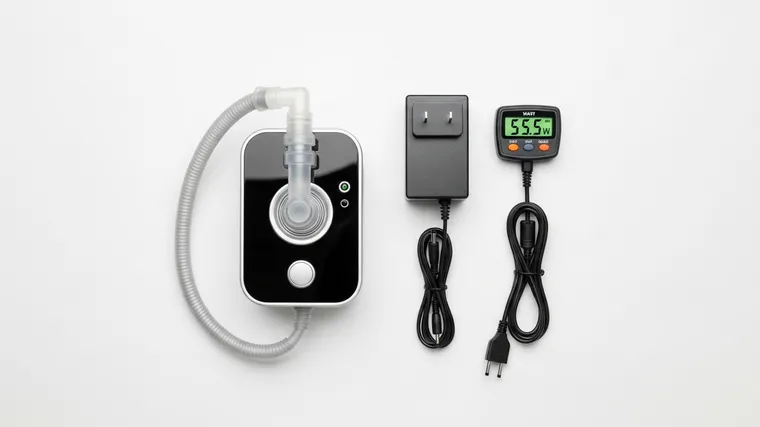
BiPAP therapy is prescribed for more severe respiratory conditions than CPAP. The machines deliver two pressure levels (higher for inhalation, lower for exhalation) and typically draw more power than a single-pressure CPAP. Battery sizing is different — and undersizing is a real risk.
BiPAP vs CPAP Power: The Core Difference
| Parameter | CPAP | BiPAP |
|---|---|---|
| Typical therapy draw (no humidifier) | 15–25W | 30–60W |
| Max rated AC adapter | 90W | 90–120W |
| Wh per night (no humidifier) | 120–200 Wh | 240–480 Wh |
| Wh per night (humidifier on mid) | 250–400 Wh | 500–800 Wh |
The motor must work harder in BiPAP mode because it cycles between two pressure levels continuously, and the pressure differential (IPAP vs EPAP) creates more airflow resistance.
Common BiPAP Models and Power Draw
| Machine | AC Adapter Rating | Estimated Therapy Draw | Approx. Wh/Night |
|---|---|---|---|
| ResMed AirCurve 10 VAuto | 90W max | 20–50W | 160–400 Wh |
| ResMed AirCurve 10 S | 90W max | 25–55W | 200–440 Wh |
| Philips DreamStation BiPAP | 90W max | 25–50W | 200–400 Wh |
| Resvent APAP/BiPAP | 65W max | 15–40W | 120–320 Wh |
| ResMed Lumis ASV | 150W max | 40–80W | 320–640 Wh |
Key point: ASV (Adaptive Servo-Ventilation) machines draw significantly more power than basic BiPAP because they continuously adjust both pressure levels. Size an ASV battery as you would a BiPAP with humidifier.
How to Measure Your BiPAP’s Actual Draw
Nameplate ratings are maximum draw, not typical. The only accurate method is measuring with a Kill A Watt power meter:
- Plug the Kill A Watt between wall and BiPAP AC adapter
- Run for one full night
- Read the kWh total in the morning; multiply by 1000 for Wh
This is the only way to know your specific BiPAP + humidifier + pressure combination’s real consumption.
Battery Sizing for BiPAP
Without Heated Humidifier
Estimated 240–480 Wh per night. Minimum battery size:
- 1 night: 600Wh (with margin) — EcoFlow River 2 Pro, EcoFlow Delta 2, Jackery 1000 v2 all qualify
- 2 nights: 1200Wh — EcoFlow Delta 2, Bluetti AC180, Jackery 1000 v2 at max settings
- 3 nights: 1800Wh — needs a larger station or DC optimization
With Heated Humidifier
Estimated 500–800 Wh per night. Minimum battery size:
- 1 night: 1000Wh — EcoFlow Delta 2, Bluetti AC180, Jackery 1000 v2
- 2 nights: 2000Wh+ — industrial or stacked power stations
Reducing BiPAP Power Consumption
- Use DC power if available. Most BiPAP machines accept a DC input — using it bypasses the AC inverter and can reduce power consumption 20–35%.
- Disable heated humidifier. This alone can cut consumption in half. Mild discomfort vs running out of power mid-night.
- Reduce pressure if clinically appropriate. Lower pressure settings draw less power. Discuss with your sleep physician.
- Use heated tube at minimum setting. The heated tube adds 10–25W.
Which Power Station for BiPAP?
For most BiPAP users without humidifier, the EcoFlow Delta 2 (1024Wh LFP) is the minimum we’d recommend — it provides a margin for humidifier use on moderate settings and can handle 2 nights without.
For BiPAP with humidifier, the Bluetti AC180 (1152Wh LFP) or a larger unit is more appropriate. The AC180’s UPS mode is particularly useful for BiPAP users — it provides seamless transfer when the grid fails, which CPAP users can wake through but BiPAP users typically cannot.
See the full comparison of 1000Wh-class power stations for detailed side-by-side.
Frequently Asked Questions
How much power does a BiPAP use?
A BiPAP typically draws 30–60W during therapy without a heated humidifier — roughly 2–4× more than a basic CPAP at therapy settings. With heated humidifier, draw can reach 80–120W. On a per-night basis, expect 240–480Wh without humidifier, 640–960Wh with humidifier on moderate settings.
Does BiPAP use more power than CPAP?
Yes, meaningfully more. CPAP maintains a single constant pressure (typically 4–25W draw). BiPAP cycles between two pressures (IPAP/EPAP) and the higher pressure differential requires more motor work. Additionally, most BiPAP users have more severe OSA and may use higher average pressure.
What size battery do I need for a BiPAP?
For one night without humidifier, 500–600Wh is the minimum safe size. For one night with humidifier, 1000Wh+. For multi-night coverage, multiply by nights needed and add a 20% safety margin. The EcoFlow River 2 Pro (768Wh) handles one night without humidifier; the EcoFlow Delta 2 or Bluetti AC180 (1000Wh+) handles one to two nights with humidifier.
Can a CPAP battery power a BiPAP?
Yes, if the battery provides pure sine wave AC output or compatible DC voltage. The same power stations that power CPAPs power BiPAPs — you just need more capacity because BiPAP draws more power per night.
What is the power draw of a ResMed AirCurve 10?
The ResMed AirCurve 10 VAuto uses a 90W max AC adapter. Real therapy draw is typically 20–50W depending on pressure settings and humidifier use. A typical night without humidifier runs 160–400Wh.