Best Battery Backup for CPAP Machines (2026) — Power Outage Guide
Why a CPAP backup battery matters
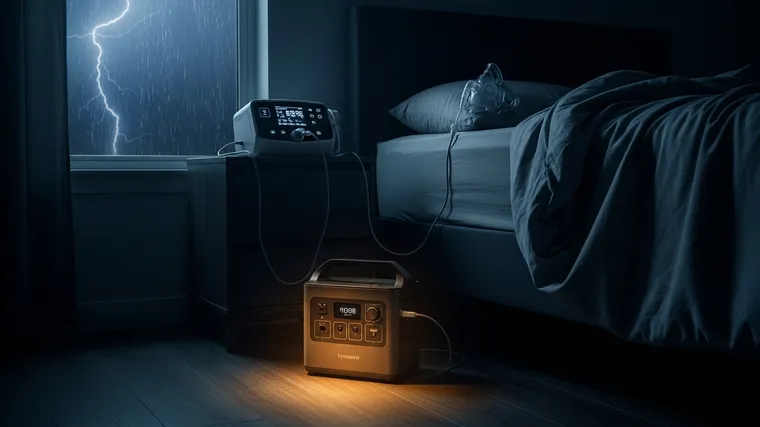
Power outages during sleep mean a lost night of therapy — and for moderate-to-severe sleep apnea, that’s a measurable health risk. Untreated apnea elevates blood pressure overnight and can trigger AFib in susceptible patients. A portable power station provides automatic continuity: you stage the battery, plug your CPAP into it, and your therapy keeps running when the grid drops.
Most portable power stations are designed for camping or contractor use. The CPAP angle matters because medical equipment has stricter power-quality requirements than a circular saw or a phone charger. This guide focuses on what to check before you buy.
How much capacity (Wh) you actually need
This is the question everyone gets wrong. The marketing says “powers a CPAP for 24 hours” — but that assumes the cleanest possible scenario.
Real-world CPAP power draw:
| Configuration | Continuous draw | Overnight (8h) total |
|---|---|---|
| CPAP only, 8-10 cmH₂O pressure | 4-7 W | 30-60 Wh |
| CPAP + heated humidifier (low) | 25-35 W | 200-300 Wh |
| CPAP + heated humidifier (med) | 40-55 W | 320-440 Wh |
| CPAP + heated humidifier (high, cold room) | 60-90 W | 480-720 Wh |
| BiPAP + humidifier | 50-80 W | 400-640 Wh |
Inverter loss: Power stations lose 10-20% in DC→AC conversion. Multiply your overnight Wh need by 1.2 to estimate battery capacity required.
Bottom line for sizing:
- 500-800 Wh: one night without humidifier (most travel CPAP setups)
- 1000-1500 Wh: one night with humidifier on low/medium
- 1500-2500 Wh: two nights without humidifier, or one night with humidifier high
- 3000 Wh+: three nights without humidifier, weekend camping with humidifier
Pure sine wave: non-negotiable
Modern CPAPs use switching power supplies that can technically tolerate modified sine wave, but every CPAP manufacturer specifies pure sine wave. Modified sine wave can:
- Cause faint audible hum through the mask hose
- Trigger over-current protection in the CPAP power supply (machine cycles on/off)
- Reduce CPAP power-supply lifespan over years of use
All major portable power stations under consideration here (Jackery, EcoFlow, Bluetti, Goal Zero) use pure sine wave inverters. If a battery doesn’t explicitly say “pure sine wave,” skip it.
Battery chemistry matters more than capacity
A 1000Wh NMC (lithium-nickel-manganese-cobalt) battery and a 1000Wh LFP (lithium iron phosphate) battery look identical on the spec sheet — but they age very differently:
| Property | NMC | LFP |
|---|---|---|
| Cycles to 80% capacity | ~500 | 3000+ |
| Heat tolerance | Lower | Higher |
| Cost-per-Wh | Lower upfront | Higher upfront, lower lifetime |
| Weight | Lighter | Heavier |
| Risk profile | Higher (thermal runaway) | Lower |
For CPAP use specifically, LFP is almost always the right choice — you’re using the battery for years, often in temperature extremes (camping, stuffy bedrooms, RV in summer), and the safety margin matters around medical equipment.
The Jackery Explorer 1000 v2, EcoFlow Delta 2, and Bluetti AC180 all ship with LFP. The original Jackery Explorer 500 still uses NMC.
What to look for, in priority order
- Pure sine wave AC output — non-negotiable, all good options have it
- Capacity matched to your CPAP setup — see sizing table above
- LFP battery chemistry — for any user who’ll cycle the battery more than once a month
- Continuous AC output ≥ 200W — protects against humidifier surge spikes
- Pass-through charging — lets you use the battery while it charges (multi-day outage scenario)
- Fast recharge — matters during recurring outages; EcoFlow’s 50-minute 80% charge is best-in-class
- Solar input — only matters if you’re off-grid or planning extended outages
Recommended pairings by use case
| Use case | Recommended capacity | Suggested model |
|---|---|---|
| One-night home backup, no humidifier | 500-800 Wh | EcoFlow River 2 Pro, Jackery Explorer 500 |
| One-night home backup, humidifier | 1000-1500 Wh | EcoFlow Delta 2, Jackery Explorer 1000 |
| Multi-night outage backup | 2000-3000 Wh | Bluetti AC200Max, EcoFlow Delta Pro |
| Frequent travel/RV with CPAP | 500-1000 Wh + LFP | EcoFlow Delta 2, Bluetti AC180 |
| Air travel CPAP-specific | <100 Wh (TSA limit) | Medistrom Pilot-24 Lite, ResMed Power Station II |
Coming next on this site
- Hands-on overnight runtime tests with ResMed AirSense 11
- CPAP runtime calculator (input your model + humidifier setting → required Wh)
- Detailed model-vs-model comparisons with measured (not estimated) numbers
Affiliate disclosure: When you buy through links on this site, we may earn a commission at no extra cost to you. This funds the testing equipment and overnight runs that produce the data on these pages.
Frequently Asked Questions
How many watt-hours do I need for one night of CPAP?
A standard CPAP without humidifier draws roughly 30-60 watt-hours per night (8 hours at 4-7 watts continuous). With a heated humidifier on low, expect 200-400 Wh per night. With heated humidifier on high in cold rooms, 500-800 Wh per night is realistic. Budget at least 500 Wh for one safe overnight session, 1000 Wh+ if you need two consecutive nights.
Do I need a pure sine wave inverter?
Yes. CPAP machines with switching power supplies will technically run on modified sine wave, but pure sine wave is recommended to avoid hum, vibration through the mask, or rare error states. All CPAP manufacturers recommend pure sine wave. Every power station we cover (Jackery, EcoFlow, Bluetti, Goal Zero) provides pure sine wave.
Can I run a humidifier on battery overnight?
Possible with 800Wh+ batteries, but the heating element consumes 4-8x more power than the CPAP motor itself. Most travel users disable the heater on battery and accept slightly drier air. If you need humidified air on battery, look at 1500Wh+ stations or accept that you'll get one night max per charge.
Does my CPAP have a built-in battery option?
ResMed AirSense 11, AirSense 10, and AirMini all support optional purpose-built batteries (Medistrom Pilot-24 Lite, ResMed Power Station II). These are smaller and lighter than universal power stations and last 1-2 nights. The tradeoff: they're CPAP-specific and can't power anything else during a multi-day outage.
Will airline TSA let me carry a portable power station?
Most full-size power stations (1000Wh+) exceed the FAA 100Wh limit for personal lithium batteries in carry-on. They're prohibited in checked baggage entirely. For air travel, use a CPAP-specific battery rated under 100Wh (e.g. Medistrom Pilot-24 Lite at 95Wh) or rent one at your destination. The Transcend Travel CPAP has a 5-pin connector designed for airline travel.